
(Reviewed by JD Jung)
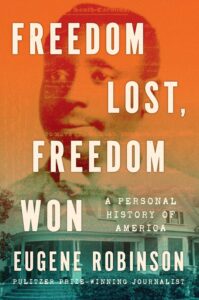

With the teaching of Black History being eliminated in many school districts, journalist Eugene Robinson is demonstrating its relevance and importance in his new book, Freedom Lost, Freedom Won: A Personal History of America. Through deep research, he was able to reconstruct his own family’s history, starting with his great-great-grandfather in South Carolina as a slave all the way forward to Trump’s second term.
On his mother’s side, his great-great-grandfather purchased his freedom in 1851, became literate, and built a successful business after the Civil War that shaped generations to come. Robinson grew up in Orangeburg, South Carolina, in a home built by his great-grandfather in 1903—a living symbol of perseverance amid systemic barriers.
Robinson reflects on how much further his family might have progressed had Reconstruction not ended prematurely and Jim Crow laws not curtailed Black advancement. His father’s lineage, though less economically secure, reveals a similar enduring faith in the American dream.
He verified oral history with the South Carolina Historical Society and various libraries. He found financial records, speeches, and letters that were preserved within his family home. The result is both a riveting memoir and accessible history lessons. He explains how the Hayes-Tllden Compromise of 1877 dismantled Reconstruction, how Confederate monuments reinforced false Civil War narratives, and how racial violence—including the Red Summer of 1919—shaped generations. Robinson shows how segregation persisted in everyday life well into the late 1960s despite legal progress.
I remember the Kent State police shootings in 1970 but was unaware of the 1968 Orangeburg Massacre where police shot unarmed Black student protesters resulting in three deaths and 28 injuries. There is so much history that Americans are not taught.
Powerful and deeply readable, Freedom Lost, Freedom Won: A Personal History of America demonstrates how national history lives within individual families. Robinson ultimately delivers a clear message: understanding America requires confronting its full past, because Black history is American history.